


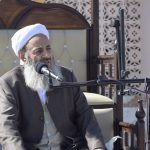
In the Eid-ul-Fitr sermon delivered on Friday, March 20, 2026, at the Grand Eidgah of Zahedan, Shaikh-ul-Islam Mawlana Abdol-Hamid pointed toward the sensitive situation of the country.
He emphasized the necessity of listening to the people’s demands, halting the continuation of losses, and strengthening ethnic and religious harmony, while conveying messages to both domestic and regional authorities.
The Country’s Difficult Ordeal and the Need to Listen to the Voice of the People
At the beginning of his speech, Mawlana Abdol-Hamid referred to the current situation of the nation, saying: “Today, our country is undergoing a difficult ordeal, and everyone must reflect.”
According to him, although it has become difficult even to speak today, it is expected of the country’s intellectuals to speak up so that the assets and lives of the Iranian people are not further destroyed.
Referring to recent developments, he added that the issues arising within the country demonstrate that the majority of Iran’s honorable people have chosen a path where necessary religious and social freedoms are available.
He stated that it has been said repeatedly that the voice of the Iranian people should be heard and that dialogue should be held with the people, who are the true owners of this country.
The Friday orator of Sunnis in Zahedan emphasized that if the people had been listened to, the country would not be in this situation today.
Shaikh Abdol-Hamid offered the compassionate advice that this should be done as soon as possible to avoid further losses. According to him, everyone thinks about the interests of the country, and if the demands of the Iranian people and the desires of the majority are addressed, it could lead to national reconciliation.
He clarified: The country needs national unity and reconciliation, and national solidarity is only possible when the demands of the people are addressed.
Warning Against the Continuation of Losses and the Need for Prudence
The outstanding Iranian Sunni scholar further stated: It becomes difficult to remain silent while watching ongoing events. When the assets and facilities of the country are destroyed, the heart bleeds, for their restoration will not be easy.
According to the Zahedan orator, wisdom lies in preventing further damage, and the sooner this action is taken, the better it will be for the country.
He insisted that the wise and the intellectuals must devise a plan for these issues.
Regarding the role of other countries, Mawlana Abdol-Hamid made it clear: Other countries are pursuing their own interests. According to him, although they claim to have come to support the Iranian people, such claims are only made as long as internal division exists.
He stressed: If the demands of the people are addressed and national interests are considered with empathy, the spread of divisions and losses can be prevented; and this is the sign of intelligence and foresight.
Regret Over Loss of Life and the Value of Human Life
Mawlana Abdol-Hamid mentioned those killed in recent events and the war, saying: All those who were killed in January (nationwide suppression of protestors) and those who died in this war are all part of the Iranian nation and are human beings.
According to him, one should weep over the loss of a human being and pray that Allah Almighty finds a way out.
Advice on Ethnic and Religious Harmony and Respect for Diverse Views
In another part of his address, he advised the people of the province of Sistan-Baluchistan and those in other ethnically and religiously diverse provinces to look out for one another, regardless of group, race, or nationality.
The Zahedan orator emphasized: Opinions and views are free, and no one can be blamed or targeted for holding a different opinion.
According to him, ideological differences even exist within a single family, and religion has granted humans freedom in belief and preference.
Mawlana Abdol-Hamid added: All people should stand together so that no one can exploit them for their own interests or confuse society.
He said more that contrary to some claims, there is no religious or ethnic problem in Sistan and Baluchistan.
Shaikh said: Religious and ethnic communities must respect each other’s rights and honor one another. Religion and belief are matters between a human and God, and no one can impose his/her belief on another.
Warning Against the Exploitation of the Public for Instability
The Friday Imam of Sunnis further advised the public not to allow anyone to exploit them to spread instability. According to him, the people have the right to choose the path they consider correct, but they must remain vigilant so that they do not become instruments in the hands of others.
Demand for Sistan’s Water Rights from the Authorities of the Islamic Emirate
In a portion of his speech, Mawlana Abdol-Hamid addressed a message to the authorities of the Islamic Emirate regarding water rights. Pointing out that water has not reached Sistan this year, he expressed that the people of this region are facing severe hardships.
He emphasized that water is the foundation of life and a basic necessity for the people; therefore, he demanded that even in cases of water shortage, there must be a just distribution, and a share must be allocated for the people of Sistan. According to him, life is impossible without water, and he expressed hope that conditions would be facilitated so that water could reach Sistan.
Call to End Clashes Between Afghanistan and Pakistan
The most influential Iranian Sunni leader called upon the authorities of Afghanistan and Pakistan to engage in dialogue with each other to end frictions and clashes, urging them not to give others the opportunity to incite conflict between the two countries.
Stressing that war is inappropriate, Mawlana Abdol-Hamid clarified that both parties are Muslims and share common historical roots and kinship.
Emphasis on the Simultaneous Prosperity of People’s Worldly Life and the Hereafter
At the conclusion of his speech, the prominent Iranian scholar expressed hope that the fighting would end and that the country would adopt a path toward a bright future. The simultaneous prosperity of the people’s worldly life and the hereafter is essential, and the notion that focus should only be placed on the hereafter is unacceptable.
He emphasized that the world was also created for human beings, and people should have access to economic prosperity.
Mawlana Abdol-Hamid ultimately stressed that people must have bread, their pockets should be full of money, and they should possess capital; because as long as poverty exists and a person’s stomach is not full, neither this world nor the hereafter can truly be sustained.








Comments