

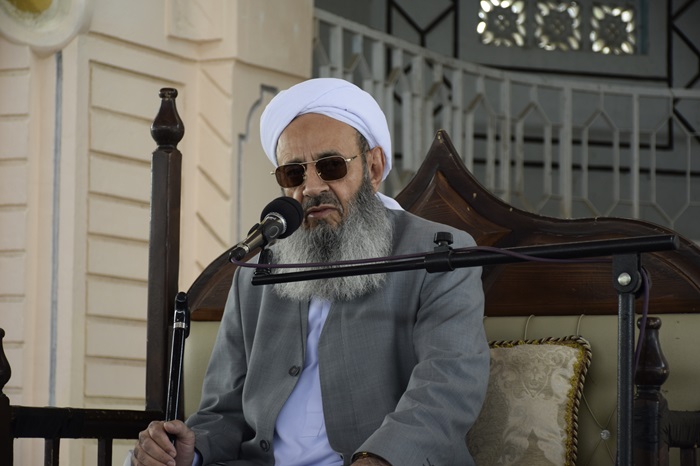
In his Friday sermon this week (November, 28th, 2025) in Zahedan, Shaikh-ul-Islam Mawlana Abdolhamid emphasized justice, public service, avoidance of violence, and the necessity of a government chosen by the people. He underlined the crucial role of freedom, fair governance, and attention to the hardships faced by the Iranian people, warning that national resources must not be spent outside the country.
🔹 The Role of Governance and the People’s Right to Choose Their Leaders
According to the Office of the Sunni Friday Imam of Zahedan, Mawlana Abdolhamid began by highlighting divine wisdom in matters of governance:
“Governance, the authority to choose leaders, and the sciences of management and politics are among the blessings God Almighty has granted to humanity—blessings not given to many other creatures. These abilities allow humans to organize worldly life, achieve a comfortable existence, and worship God with ease.”
He added:
“God has given humans freedom so that they can plan and manage their worldly lives properly. Those placed in charge must think about people’s well-being—ensuring security, improving the economy and livelihoods, advancing society, and expanding knowledge—so people can live and work comfortably while governments meet their needs through sound planning.”
🔹 The Divine Expectation from Governments: Serving the People
Mawlana Abdolhamid stressed:
“What God Almighty desires from governments and leaders is that they think about the people—their welfare, comfort, and ease—and that they serve the nation.”
He emphasized the high status of justice in leadership:
“No worshipper, ascetic, or devout person has as much reward before God as a just ruler. A just leader who sees all people—ethnic groups, denominations, Muslims and non-Muslims—equally and serves them with fairness holds the highest rank in the sight of God.”
🔹 The Model of Governance in Islamic Tradition
He stated:
“A capable leader must be strong, competent, and just, without discriminating among the people. The best model of governance is the example of the Prophet Muhammad (peace be upon him).”
Mawlana Abdolhamid recalled historical examples:
“When Salman the Persian embraced Islam, the Prophet said that Salman was among his household. A stranger could attain such a status in a system that truly represented God’s vicegerency on earth.”
He continued:
“Bilal al-Habashi, a Black man and a former slave freed by Abu Bakr al-Siddiq, rose to such dignity that he was instructed by the Prophet to call the adhan in the Sacred Mosque on the day of the conquest of Mecca and later in Medina. People were proud of him. The honorable became more honored, and even slaves gained dignity. Human sanctity was elevated, and even the rights of animals were observed.”
🔹 Criticism of Inequality and the Need to Address Iran’s Internal Problems
He emphasized:
“Justice is the greatest merit and the best act of worship in the sight of God.”
Then he warned:
“It is said: ‘A lamp that is needed at home must not be taken to the mosque.’ When the people of Iran are struggling, the nation’s wealth must not be spent elsewhere. The Iranian people are in need and face difficulties; their problems must be addressed.”
🔹 The Importance of Fundamental Freedoms and Rejecting Violence
According to Mawlana Abdolhamid:
“Expanding justice, fairness, equality, and all fundamental freedoms; treating people with wisdom; and avoiding violence are vital. Harshness only breeds more harshness. Wisdom must be applied. Violence is not the answer everywhere; dialogue and engagement work better.”










Comments