

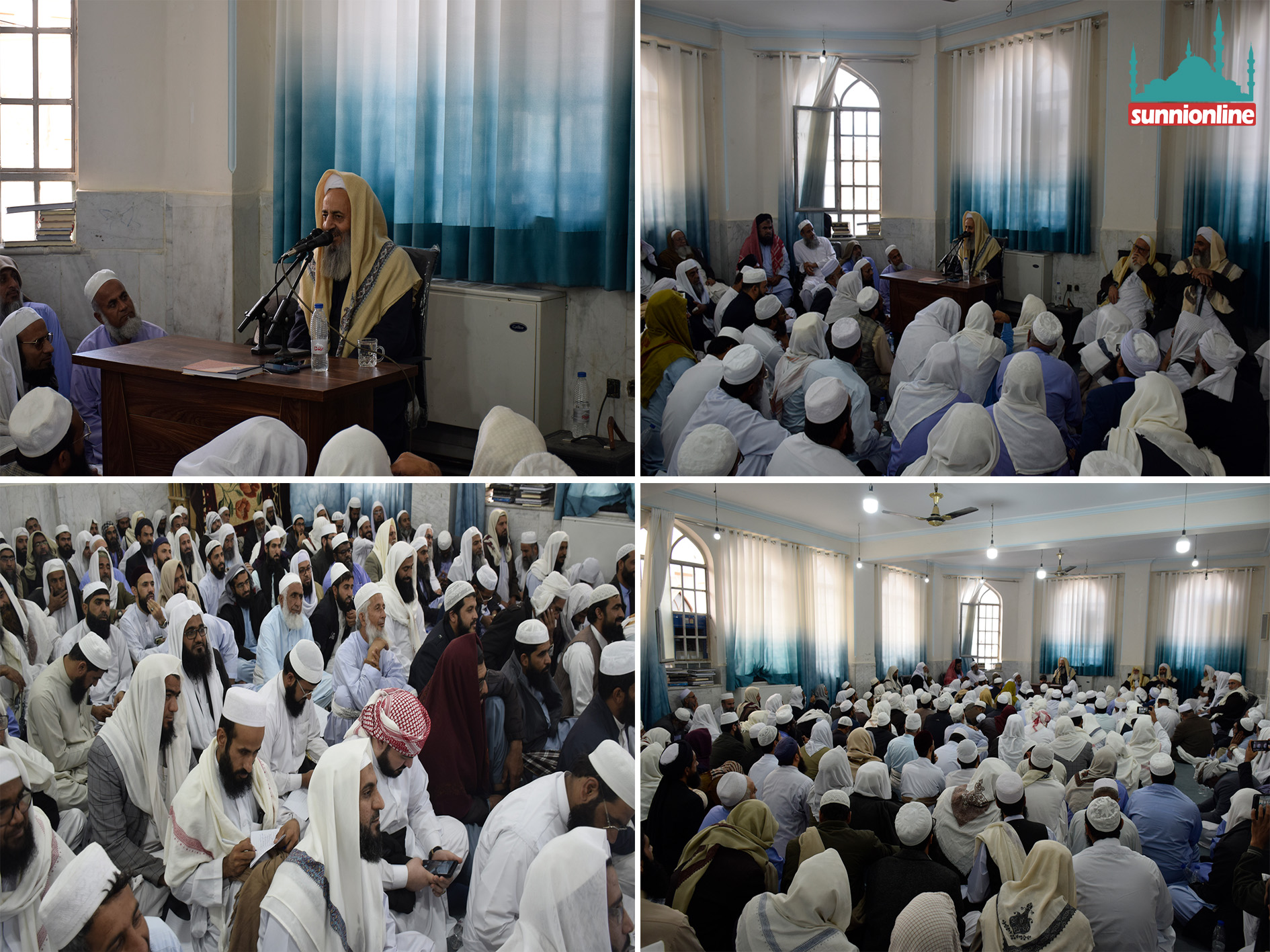
Shaikh-ul-Islam Mawlana Abdolhamid, speaking today, Wednesday (December 24th, 2025), at a meeting between graduates and beneficiaries of Dar ul-Ulum Zahedan from Iranshahr, Delgan, Fanouj, and Lashar and their teachers, highlighted the role of deeds in reforming and disciplining the self. He described prayer as the most influential act of worship, emphasized adherence to the Sunnah of the Noble Prophet Muhammad (peace and blessings be upon him) as essential for spiritual and psychological well-being, and stressed the importance of initiative and creativity in performing religious activities.
🔹 All Good Deeds Aim at Reforming and Disciplining the Self
According to the Information Portal of the Office of the Sunni Friday Prayer Leader of Zahedan, Shaikh-ul-Islam Mawlana Abdolhamid stated at the beginning of his remarks:
“Striving (mujāhadah) must be for Allah, not for name, fame, or worldly gain. What matters is that Allah the Exalted calls us to sacrifice and struggle in His way. Our true success is not found in sleep, rest, comfort, or recreation, but in striving. Striving opens the doors of divine help and victory. Divine success and support do not come from our or our children’s comfort; rather, goodness comes to meet us during striving.”
He added:
“The first struggle must be with our own selves. The greatest struggler is the one who combats the self and compels it to obey Allah. The Companions did not care for hollow or pretentious titles; their focus was entirely on truths and realities. The self attempts to divert us from the path of goodness—even when we pray or perform righteous deeds, it seeks to guide us toward seeking people’s praise or personal gain. Prayer, fasting, and all good deeds serve to combat the self and reform it.”
🔹 If Prayers Are Not Properly Performed, Society Will Not Be Transformed
Continuing, the Director of Dar ul-Ulum Zahedan said:
“We must review our deeds and ask ourselves whether, during prayer, we were truly with Allah or whether our minds were elsewhere. Humility, helplessness, and presence of heart in prayer and deeds are crucial, and this requires striving. When standing for prayer, struggle against the self and direct your intention sincerely toward Allah. Prayer is a private communion with Allah. If our prayers are not properly performed, they will not bring about transformation. Allah the Exalted looks at the heart; if the heart is not turned toward Him, such a prayer will not result in divine support.”
He added:
“If the self is disciplined and reformed through striving, it becomes a person’s best ally and helper—it reproaches one for shortcomings and sins and guides one to obey Allah. Let us examine our deeds so that all are sincerely for Allah; otherwise, it is shameful if, during prayer, the heart is not devoted to Allah. Allah tests us through the self and Satan; this is a difficult trial, but if we strive, Allah grants support and reforms the self.”
🔹 A Person Is Reformed Through Good Deeds and Following the Way of the Prophet (peace and blessings be upon him)
Referring to the effect of fasting on reforming the self, Shaikh-ul-Islam Mawlana Abdolhamid said:
“Fasting is one of the most remarkable acts of worship for reforming the self. A person is reformed through these deeds. Allah the Exalted has prescribed a method for everything, and the method for reforming a human being lies in performing deeds, obligatory acts, supererogatory acts, and following the way of the Prophet Muhammad (peace and blessings be upon him). Let us devote ourselves to voluntary prayers, remembrances, litanies, and the Qur’an, for the Qur’an is the greatest remembrance. Allah the Exalted has placed an effect in every deed and remembrance. Just as prayer includes diversity—from recitation, bowing, and prostration to remembrances, standing, supplication, and invocation—other acts of worship also include diversity.”
He added:
“On the path of Allah, success belongs to the one who observes this diversity. The Messenger of Allah (peace and blessings be upon him) both performed prayer in the most beautiful manner and fulfilled other acts of worship, observing this diversity. Religion is a complete and comprehensive system, and it brings transformation to a person only when all of its dimensions are practiced. Worship Allah and perform deeds correctly; then states of supplication, devotion, humility, and earnest pleading will arise in the heart. Let us examine our deeds—when we invite others to something, how do we ourselves act, and how is our conduct toward family and people?”
🔹Spiritual and Psychological Well-Being Is Embedded in the Sunnah of the Prophet (peace and blessings be upon him)
Mawlana Abdolhamid emphasized: “We should strive to reform our deeds and follow the way of the Prophet Muḥammad (peace and blessings be upon him). Using the miswāk (siwāk – a natural teeth-cleaning twig), applying kohl (kuḥl – eyeliner traditionally used for eye care), and sleeping early at night are in accordance with fiṭrah (human nature) and the Sunnah (Prophetic tradition). Spiritual and psychological well-being is embedded in the Sunnah. Today, life has strayed from its natural path, and many problems and illnesses have emerged; we must strive to revive the Sunnah, which aligns with fiṭrah, in our lives. Be attentive to the Sunnah and send abundant salawāt (blessings and salutations) upon the Prophet; these salawāt bring us closer to him, strengthen the connection, and positively influence our moral and spiritual development. Strive to reform others, and in doing so, your own shortcomings will be compensated, and you too will be reformed. Focus earnestly on two things: spreading knowledge and calling people to the way of Allah.”
He also highlighted the rise of anti-religious activities: “Today, propaganda is being spread against the essence of religion, the Qur’ān, and the Prophet Muḥammad, and kufr (disbelief/irreligion) is spreading rapidly. Youth and various segments of society are being influenced. We must work to bring religion into people’s lives, as religion serves as a deterrent and prevents corruption and sin. Today, calling people to the way of Allah, is a duty upon us.”
🔹Opium Cultivation Is a New Plague in the Region
The Director of Dar ul-Ulum Zahedan expressed concern about the spread of opium cultivation: “Opium cultivation is a new plague spreading in the region and must be eradicated. This requires effort, planning, and cooperation. With sincere prayer, supplication, and striving, Allah grants support to those who struggle and strive; His words leave an impact and bring reform.”
Mawlana Abdolhamid also emphasized the importance of activity in cyberspace: “Many people have the ability to engage positively online, answer people’s doubts and questions, and defend the faith. Strive, work diligently, and call to Allah so that you remain steadfast. If you work, Allah will protect you and preserve you until the last moment. When the call is to Allah, and you support God and the objectives of the Prophet, the religion will remain alive among the people; but if there is neglect, Allah brings punishment and replaces them with others. Defend the religion and stand by it.”
🔹Do Not Be Extravagant or Raise Living Costs Unnecessarily
He continued: “Attachment to worldly life creates problems. Avoid extravagance and do not unnecessarily raise living costs, or you will face difficulties. Resolve to invite people to Allah with wisdom. Act wisely and do not create hardship for others. Allah has taught wisdom, and if you strive, He will show you the paths of goodness, self-reform, and guidance. Overcoming the self is the greatest victory.”
🔹People Need Role Models; Scholars Have Always Been Role Models
In conclusion, Mawlana Abdolhamid stressed the need for creativity and initiative in religious activities: “Work collectively, sit together, consult, and avoid repetitive reports. Be innovative. Live among the people, stay close to society, think for the community, defend people’s rights, and do not isolate yourself. During floods, plagues, or other hardships, stand with the people; in this way, people are guided better and more readily accept your advice. Be ahead of the people; they need role models, and scholars have always been role models in every era. Arrive at the mosque earlier than the people and maintain presence in the mosque.”








Comments