

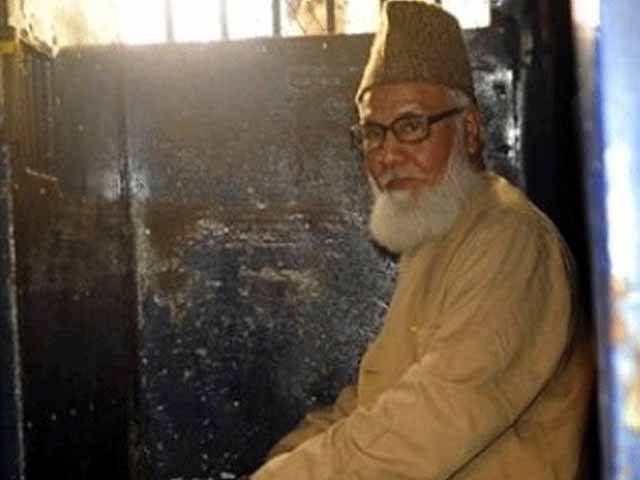
Bangladesh has executed Motiur Rahman Nizami, head of the banned Jamaat-e-Islami party, for war crimes committed during the 1971 war of independence to break away from Pakistan, the country’s law minister said.
Nizami was hanged at Dhaka Central jail at one minute past midnight local time on Wednesday after the Supreme Court rejected his final plea against a death sentence imposed by a special tribunal for genocide, rape and orchestrating the massacre of leading intellectuals during the war.
In a sign of divided opinion over the hanging, scores of protesters came out in the streets of Dhaka to condemn the execution, while hundreds of others cheered the move.
“We have waited for this day for a long 45 years,” said war veteran Akram Hossain. “Justice has finally been served.”
Thousands of extra police and border guards were deployed in the capital, Dhaka, and other major cities to tighten security as Jamaat-e-Islami called for a nationwide strike on Thursday in protest against the execution.
Previous similar judgments and executions have triggered violence that killed around 200 people, mainly Jamaat activists and police.
Al Jazeera’s Tanvir Chowdhury, reporting from Dhaka, said calling for a nationwide shutdown was the usual reaction by Jamaat-e-Islami following an execution or death sentence against one of its members.
But he added that protests were not likely to be that intense.
“The party itself is very marginalised right now. Most of the members are either behind bars or on the run,” Chowdhury said.
Nizami had been in prison since 2010.
The party denies that its leaders committed any atrocities. Calling Nizami a “martyr”, it said he was deprived of justice and made a victim of a political vendetta.
Five opposition politicians, including four Jamaat-e-Islami leaders, have been executed since late 2013 after being convicted by the tribunal.
David Bergman, an investigative journalist in Dhaka, told Al Jazeera that there had been long-standing allegations against Nizami since the end of the war.
“So the fact that there was a trial in which he was accused of these crimes is not itself political. However, it is true to say that there have been concerns expressed by rights organisations about the process of his trials,” he said.
“There are no doubts that many members of Jamaat-e-Islami are concerned about trials and executions targeting its members, and the party itself is subject to significant repression.”
Hundreds of people, mostly university students, joined a procession from Dhaka University to celebrate the execution [Mahmud Hossain Opu/Al Jazeera]
The war crimes tribunal set up by Prime Minister Sheikh Hasina in 2010 has sparked violence and drawn criticism from opposition politicians, including leaders of Jamaat-e-Islami, that it is victimising Hasina’s political opponents.
According to the Bangladesh government, about three million people were killed and thousands of women raped during the 1971 war in which some factions, including the Jamaat-e-Islami, opposed the break from what was then called West Pakistan.
The execution comes as the country suffers a surge in violence in which atheist bloggers, academics, religious minorities and foreign aid workers have been killed.
In April alone, five people, including a university teacher, two gay activists and a Hindu, were hacked to death.
Source: Al Jazeera






Comments