


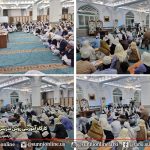
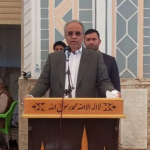
Shaikh-ul-Islam Mawlana Abdol-Hamid, speaking at the Friday prayer congregation in Zahedan on November 13, 2026, addressed the severe economic hardships facing the public and the military threats confronting the country. Urging the authorities to engage in direct negotiations with the opposing side, he called for serious efforts to avert war and secure the lifting of sanctions against the country.
War and Economic Hardships Have Cast a Shadow over the Country and Its People; Preventing a Devastating War Is Also a Form of Resistance
Mawlana Abdol-Hamid, the Friday Imam of Sunnis in Zahedan, said: The country is going through one of the most critical periods in its history. On the one hand, it is grappling with economic hardships, while on the other, the threat of war looms over it. The people are deeply distressed and anxious.
“Given the devastating consequences of war for nations and countries, our appeal to the authorities and decision-makers is to make every possible effort to prevent another war from being imposed on the country. This, too, is a form of resistance in its own right.”
Just as the Qur’an Speaks of Jihad, It Also Emphasizes Peace; Why Do Those Who Speak Only of War Ignore the Treaty of Hudaybiyyah?
Responding to criticism from some circles over his calls for peace, the Friday Imam of Sunnis in Zahedan referred to the teachings of the Qur’an and the Prophet’s Seerah, saying: “Some people with a superficial understanding criticized me, arguing that the Qur’an commands jihad while I advocate peace. Yet the Qur’an speaks of peace just as it speaks of jihad. War and peace each have their proper place, and both must be pursued at the appropriate time. The Qur’an states:
‘If they incline towards peace, then you too should incline towards it.’ (Qur’an 8:61)
“Allah Almighty has instructed us that if the enemy expresses a willingness to make peace and proposes an agreement, we should accept that offer,” he added more.
Referring to the Treaty of Hudaybiyyah, Shaikh Abdol-Hamid asked: “Why do those who speak only of war fail to consider the Treaty of Hudaybiyyah? At Hudaybiyyah, the Messenger of Allah ﷺ accepted extremely harsh terms imposed by the enemy. This caused distress and dismay among some of the Companions, but the Prophet ﷺ, owing to his foresight and broad vision, accepted those difficult conditions.”
Sometimes True Courage Lies in Accepting an Agreement and Preventing a Devastating War
Mawlana Abdol-Hamid said: “Courage and bravery do not consist solely in fighting wars. Sometimes, true courage lies in accepting an agreement and preventing a war that would entail enormous human and material losses. Today, the most advanced weapons have been amassed around the country, and the country is facing serious threats.”
We Believe the Opposing Side Is Tired of War and Has Little Desire to Continue It; Authorities Should Seize This Opportunity to Keep War Away from the Country
The Friday Imam of Sunnis in Zahedan further stated: We have the impression that the opposing side has grown tired of war and is no longer interested in continuing it. Moreover, taking into account the results of the recent elections in the United States and Israel, more favorable conditions and opportunities now exist for peace and an agreement in the region, as well as for keeping the threat of war away from our country.
“Therefore, our sincere appeal is that the authorities take advantage of this opportunity and the favorable circumstances and do everything within their power to prevent war from reaching our country,” he added more.
Addressing the Demands and Needs of the Iranian People Is the Greatest Service to the Country
The Friday Imam of Sunnis in Zahedan described addressing the demands and needs of the Iranian people as the greatest service that could be rendered to the country. He said: “The country and its people are facing exceptionally severe economic conditions. Under the present circumstances, I do not consider any service more important than paying attention to the demands and needs of the Iranian people.
“Efforts must be made to have the sanctions lifted so that the Iranian nation can engage in trade freely and its assets can be returned to it. The country is facing the most severe economic blockade in its contemporary history. The true test of the authorities’ competence and capabilities will come when they succeed in freeing the country from all these wars and hardships,” he underlined.
Why Don’t the Authorities Negotiate Directly with the Opposing Side?
Mawlana Abdol-Hamid proposed direct negotiations between Iran and the United States, saying: “I have always wondered why, when we have our own rights and demands, we do not engage in direct negotiations. Mediators may fail to convey our position and demands accurately or defend our rights as effectively as they should.
He said more: “Why don’t you sit down with the opposing side and negotiate directly?” he asked the authorities.
“The Messenger of Allah ﷺ held direct negotiations with the leaders of the Meccan polytheists who were commanding the wars against the Muslims. Therefore, our proposal is that negotiations should be conducted directly and should lead to an honorable agreement,” Shaikh Abdol-Hamid urged.
Ending Executions Has Always Been One of the People’s Demands
In another part of his address, Mawlana Abdol-Hamid referred to the rising number of executions in drug-related cases, saying: “Executions for drug-related offenses have been taking place since the early years of the Revolution. We are now also receiving reports that approximately 7,000 prisoners convicted in drug-related cases are facing execution, 2,000 of whom are from Sistan and Baluchistan Province.
“Ending executions has always been one of the people’s demands, and we, too, have repeatedly raised it as a public demand,” he further said.
The Judiciary’s Decision to Halt Drug-Related Executions Is a Positive Step; We Expect Executions to Be Suspended in All Other Areas as Well
Mawlana Abdol-Hamid said: “We regard every positive step taken in response to the people’s demands as a welcome development and consider it worthy of recognition.”
He added: “The head of the judiciary has issued an order to halt executions in drug-related cases, and the Judicial Commission of Parliament has also made efforts in this regard. These are positive steps. Our expectation is that executions will be halted in all areas and that the death penalty will be limited exclusively to cases of Qisas (retributive justice), which is explicitly prescribed in the Qur’an.
“Even in cases of Qisas, the decision rests with the victim’s legal heirs, who can waive their right to retribution. The judiciary’s role is simply to implement the ruling of Qisas.”
The International Community and the World’s Nations Do Not Look Favorably Upon the Death Penalty; Ending Executions Is in the Government’s Interest
The Friday Imam of Sunnis in Zahedan further stated: “The international community, international organizations, and human rights bodies do not approve of the death penalty. The nations of the world, including the Iranian people, do not view it favorably and are concerned about this situation. Therefore, ending executions is in the interests of the government, the country, and the Iranian nation.”
Greater Attention Must Be Paid to Infrastructure Development in Sistan and Baluchistan
In another part of his Friday sermon in Zahedan, Mawlana Abdol-Hamid welcomed Engineer Mansour Bijar, Governor of Sistan and Baluchistan Province, and his accompanying delegation. He also highlighted some of the province’s challenges.
He said: “The lack of adequate infrastructure in Sistan and Baluchistan is one of the province’s major problems, yet it has received relatively little attention.
“One of the important priorities of the hardworking and dedicated governor of Sistan and Baluchistan has been to focus on infrastructure development, including railways and roads. Nevertheless, these sectors still require greater attention and investment,” he added more.
Proper Management of Sistan and Baluchistan’s Potential Can Eliminate Poverty in the Province and Help Meet the Country’s Needs
The Friday Imam of Sunnis in Zahedan further emphasized: “Sistan and Baluchistan possesses enormous and valuable potential and capabilities. If these resources are managed properly, they can not only create employment opportunities for the people of the province and help eradicate poverty, but also contribute to meeting the needs of the entire country.
He said: “One example of this can be seen in the current wartime circumstances. Thanks to the effective management of the governor of Sistan and Baluchistan, a substantial portion of the country’s food supplies, along with many other essential commodities, has been distributed throughout the country through the province’s border crossings. Officials at the central government level have also expressed their satisfaction with these efforts.”






Comments